The Cleveland Museum of Art
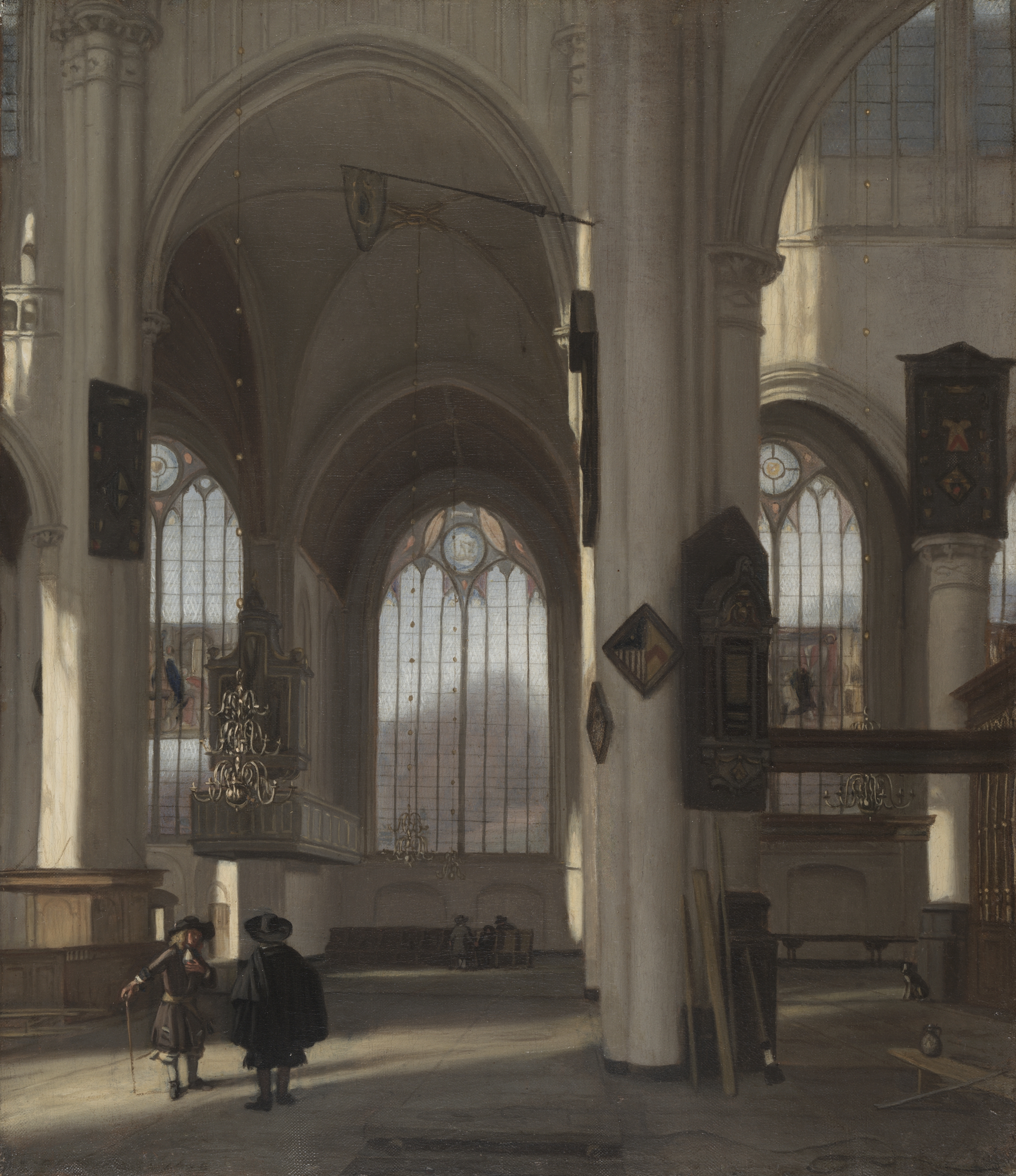
Interior of a Church
Description
Although this spacious church interior is largely imaginary, Emanuel de Witte’s precise description of architectural forms convinces us that he depicted an actual place. To create a sense of familiarity, he included some specific architectural features from the Oude Kerk (Old Church) in Amsterdam. In the late 1500s, militant Protestant sects occupied Catholic churches in the Netherlands and stripped them of rich decorations and “idolatrous” images. The resulting spare, whitewashed interiors became a favorite subject of Dutch artists, who were intrigued by the interplay of light and shadow over the unadorned walls, and by the challenge of depicting perspectival space.
Provenance
Theodor Stroefer [1843-1927], Nürnberg; Family of Theodor Stroefer, Nürnberg; (Julius Böhler, Munich, Stroefer sale, Oct. 28, 1937, no. 122 [13,000 Reichsmarks, sold to Curt Bohnewand)1; Curt Bohnewand [1888-1966], Berlin and Rottach-Egern, Germany1; (Kunsthaus Lempertz, Cologne, Bohnewand sale, March 28, 1969, no. 25, probably sold to Schaeffer Galleries); (Schaeffer Galleries, New York, NY, sold to the Cleveland Museum of Art); The Cleveland Museum of Art, Cleveland, Ohio
Dimensions
62 × 54 cm
Movement / Period
Accession No
1971.1
Official Citations
Curatorial Affinity Stream
Continuing the Universe of Emanuel de Witte (Dutch, c. 1617–1692)
European Painting and Sculpture • Netherlands • Harmonious Works & Contemporaries
Continuous Discovery