The Cleveland Museum of Art
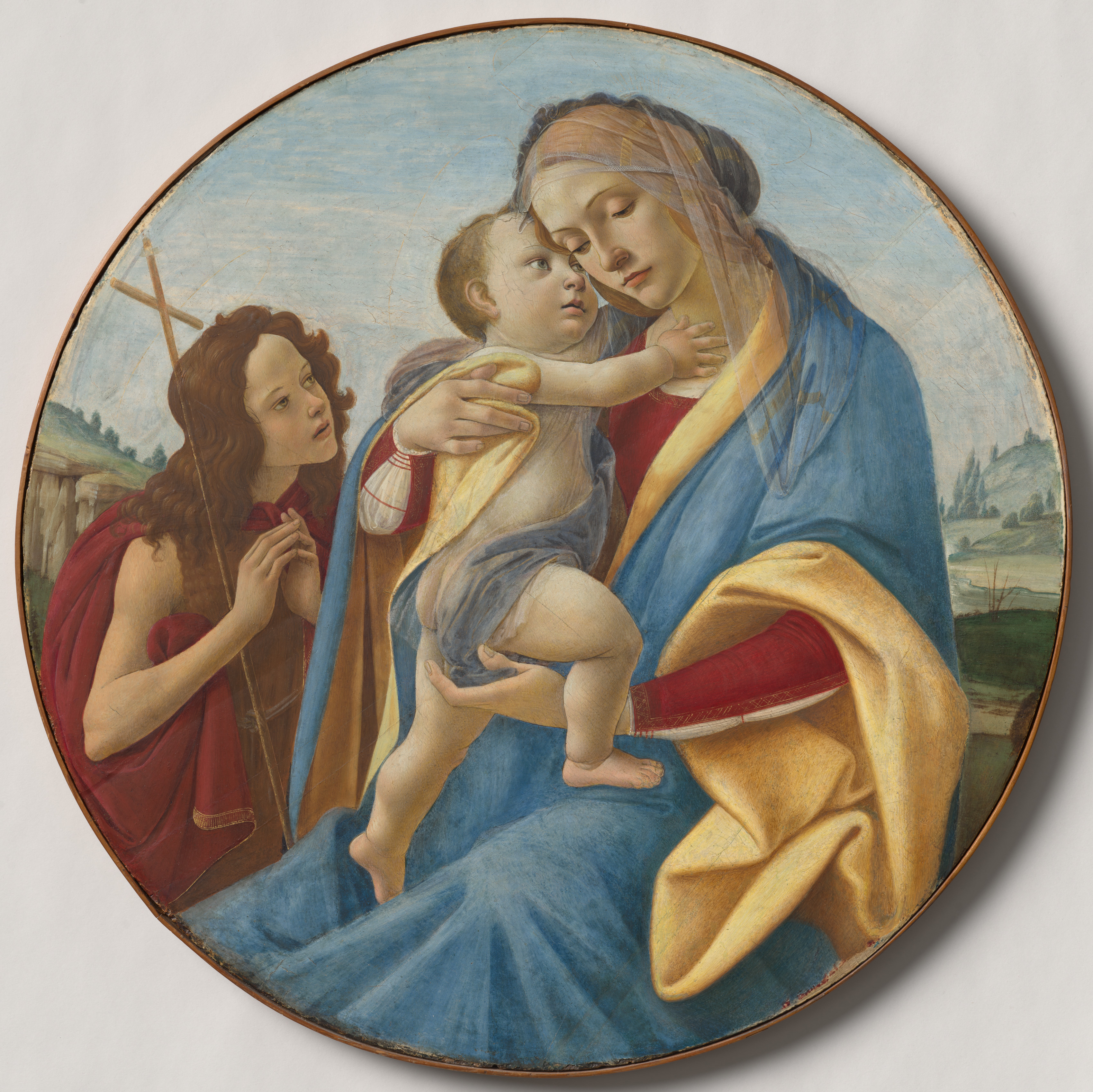
Virgin and Child with the Young Saint John the Baptist
Description
The perfectly round form, called a tondo, became popular during the 1440s, especially in Florence. Made for domestic settings instead of churches, the circular format challenged the artist to create a harmonious, balanced composition within this more difficult shape. The attribution has been a matter of debate. Botticelli often collaborated with students, including Filippino Lippi, who would himself become a significant painter. Few specialists have doubted that Botticelli executed the central passages: the delicate modeling of the faces, the graceful poses, the figures’ profound interiority, and the diaphanous veil are the artist’s hallmarks. However, someone else in Botticelli’s studio probably painted Mary’s blue garment, also the most heavily restored part of the painting.
Provenance
Robert Hoe III [1839-1909], New York, NY, after his death, held in trust by his estate1; (Hoe sale, American Art Association, New York, Feb. 15, 1911, to Arthur Hoe); Arthur I. Hoe [1880-1956], Bedford Hills, NY 1; (Ehrich Galleries, New York) 1; Baron Michele Lazzaroni [1863-1934], Rome 1; (Guglielmo Canessa, Milan, Italy) 1; Private collection, Milan 1; (Iolanda d'Antoni, Lugano, Switzerland, sold to the Cleveland Museum of Art); The Cleveland Museum of Art, Cleveland, OH
Dimensions
Recorded in archive
Movement / Period
Accession No
1970.160
Official Citations
Curatorial Affinity Stream
Continuing the Universe of Sandro Botticelli (Italian, 1444/45–1510)
Medieval Art • Italy, 15th century • Harmonious Works & Contemporaries
Continuous Discovery